
Why More Businesses Are Adopting Co-Managed IT Instead of Choosing One or the Other
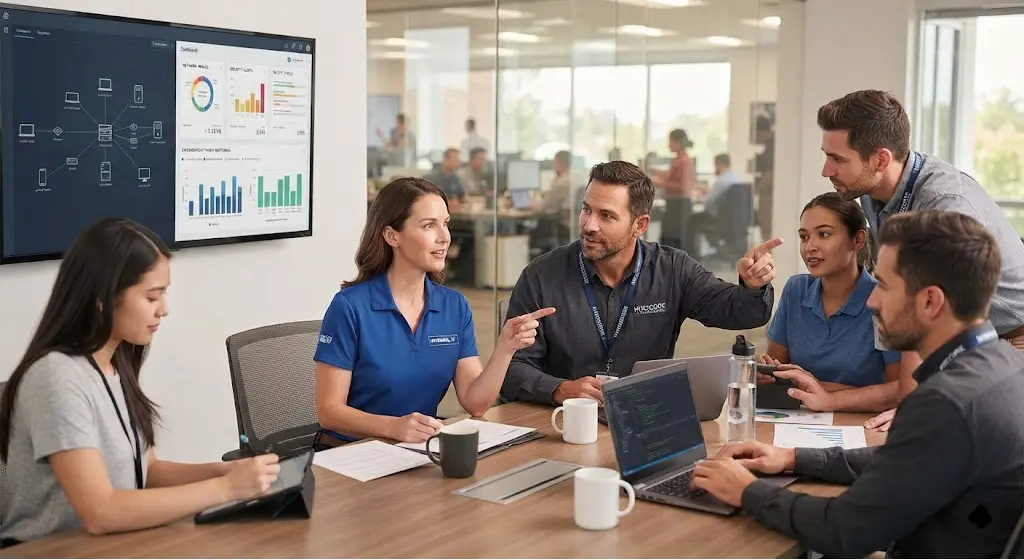
For a long time, businesses generally approached IT as a binary decision: build an internal team, or outsource everything to a managed service provider. That framing is becoming less common. A growing number of businesses are landing on a middle path, co-managed IT, where an internal team and an outside provider work together rather than one fully replacing the other.
This shift is not simply a trend or a marketing term. It reflects a practical recognition that neither pure in-house IT nor complete outsourcing fits the reality of how most growing businesses actually operate.
Why the Binary Choice Stopped Making Sense
The traditional in-house versus outsourced framing assumes a business’s IT needs are uniform enough that one model can cover everything well. In practice, IT has fragmented into distinct specialties, cybersecurity, cloud infrastructure, compliance, networking, and general help desk support, each of which requires different expertise to manage well.
A small internal team, however capable, cannot realistically maintain deep expertise across all of these areas while also handling daily support demands. A fully outsourced provider, meanwhile, may not offer the same on-site familiarity and immediate physical presence that some businesses value for hands-on issues. Co-managed IT emerged as a direct response to this mismatch, letting businesses combine the strengths of both approaches rather than accepting the limitations of either one alone.
What Is Actually Driving the Shift Toward This Model
Several forces are pushing businesses toward co-managed arrangements specifically. Cybersecurity has become specialized enough that few generalist internal IT staff can keep pace with the evolving threat landscape on top of their other responsibilities, making outside expertise in this specific area increasingly necessary even for businesses that want to retain an internal team.
Coverage expectations have also shifted. Businesses increasingly expect IT support to be available outside standard business hours, which a small internal team cannot realistically provide without significant overtime costs or burnout. Bringing in an outside provider specifically for after-hours coverage, while keeping the internal team focused on daytime support, addresses this gap without requiring the business to build out a much larger internal department.
How Businesses Are Structuring These Arrangements
There is no single template for a co-managed relationship, but a common pattern has emerged. The internal team typically retains responsibility for on-site hardware issues, direct employee relationships, and day-to-day help desk support, while the outside provider takes on cybersecurity monitoring, backup and disaster recovery, compliance requirements, and after-hours coverage.
The businesses that get the most value from this structure define the division of responsibility clearly and explicitly, rather than leaving it informal and hoping the two sides naturally sort out who handles what. Ambiguity about ownership is one of the more common ways co-managed arrangements fail to deliver their intended benefit.
Why This Model Appeals Particularly to Growing Businesses
Businesses that have grown enough to justify hiring internal IT staff but not enough to build a full specialist department are often the strongest fit for this model. Rather than facing a choice between the cost of a much larger internal team or giving up the institutional knowledge an internal hire provides, co-managed IT lets a business retain what already works internally while adding the specialized coverage that growth has started to demand.
This is particularly relevant for businesses in regulated industries, where compliance requirements often exceed what a generalist internal hire can reasonably be expected to manage while also handling daily support work.
What to Watch for When Considering This Model
Not every co-managed relationship is structured well from the start. Businesses considering this approach should look for a provider willing to work collaboratively with an existing internal team rather than one that treats co-managed engagements as a lesser version of a fully outsourced contract. The provider should be able to clearly articulate how responsibilities will be divided and how the two teams will communicate and escalate issues to each other.
How Mindcore Technologies Supports Co-Managed IT Arrangements
Mindcore Technologies has spent more than 30 years helping businesses build effective co-managed IT relationships that strengthen an existing internal team rather than sidelining it. Under the leadership of Matt Rosenthal, CEO of Mindcore Technologies, the company delivers AI-powered IT and cybersecurity solutions that include co-managed engagements built around each client’s existing internal capabilities and specific coverage gaps.
Businesses working with Mindcore in a co-managed capacity get clearly defined responsibilities from the start, along with the specialized cybersecurity, compliance, and after-hours coverage that most internal teams cannot realistically build on their own.
Conclusion
The shift toward co-managed IT reflects a practical response to how IT needs have actually evolved, rather than a passing trend. Businesses that once faced a binary choice between building everything internally or outsourcing everything are increasingly finding that a well-structured combination of both delivers stronger coverage than either extreme on its own.
